

Build Smart: IoT Engineering from Zero to Deployment
Imagine walking into a room and the lights adjust automatically. A farmer in Eastern Province checks soil moisture on his phone from 50 kilometres away. A hospital in Kigali receives an alert before a medicine refrigerator fails. A factory knows a pump is about to break down, three hours before it happens.
None of this is magic. It is engineering. And by the end of this course, you will know exactly how to build every one of those systems.
This course takes you from absolute zero: resistors, breadboards, and blinking LEDs. All the way to deploying a cloud-connected, security-hardened, AI-powered IoT system of your own design. Every lesson produces something that actually works. Every concept is demonstrated on real hardware you can hold in your hand.
Who built this and why?
Rwanda is one of the fastest growing technology economies in Africa. Smart agriculture, connected healthcare, industrial automation, and smart city infrastructure are no longer future ambitions; they are projects that are being funded and deployed right now. But there is a gap: the country has ambition and investment, but not enough engineers who can actually build these systems at the hardware level.
This course exists to close that gap.
It was designed for the Rwandan context specifically from the sensors that make sense for local agriculture and healthcare, to the cloud platforms accessible on affordable internet.
What will you actually build?
You will not spend this course watching someone else build things. You will build them yourself.
By Unit 5 you will have an ESP32 publishing sensor data to the cloud over encrypted MQTT. By Unit 7 you will have a multi-sensor smart system making autonomous decisions (running fans, pumps, and alarms) without any human in the loop. By Unit 8 you will have secured that system with TLS certificates, access control lists, and credentials no one can steal. By Unit 9 you will be pulling that sensor data into Python, cleaning it, finding hidden patterns, and training a machine learning model that predicts the future.
And then comes the Capstone. You will design an original IoT system, build it on real hardware, connect it to the cloud, secure it, analyse its data, document it professionally, and demonstrate it live. Something you built. Something that works. Something you can put in your portfolio and show to anyone.
What makes this course different?
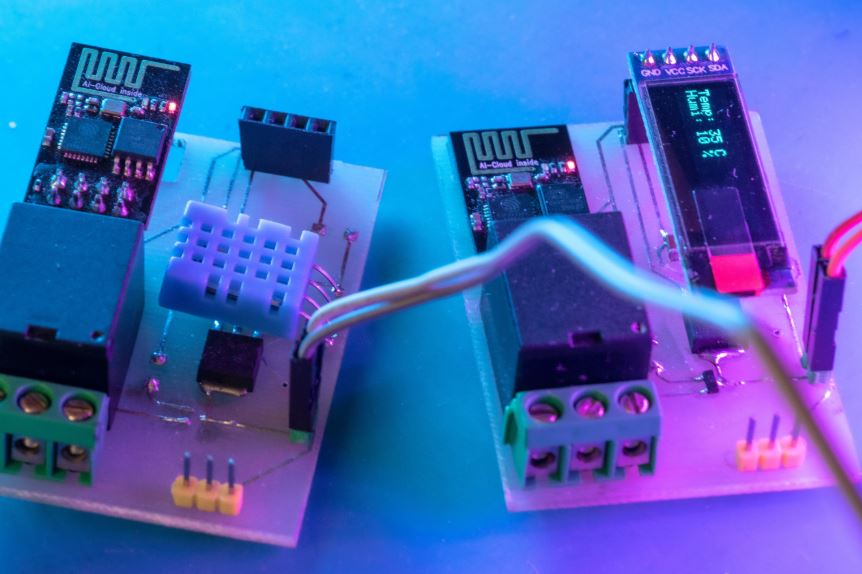
No simulation. Every circuit is wired on a real breadboard. Every firmware runs on a real ESP32. Every dashboard connects to a real cloud platform. If it does not work, you debug it; which is exactly how real engineering works.
No skipping the hard parts. Most IoT tutorials show you how to blink an LED and call it IoT. This course covers what professionals actually need to know: non-blocking firmware architecture, MQTT topic design, TLS certificate generation, MQTT access control lists, and temporal train-test splits in machine learning. The hard parts are where the real learning happens.
No guessing about what you need. The course is structured around 10 units that build directly on each other. Every skill you learn in Unit 3 is used in Unit 5. Every cloud concept from Unit 6 is secured in Unit 8. Every sensor dataset from Units 1 through 7 becomes the training data in Unit 9. Nothing is wasted.
No certificate without competence. The final assessment is not a multiple choice exam. It is a live demonstration of a working system you designed and built yourself. You either built something that works or you did not.
Who is this course for?
This course is built for people who want to build things; not just understand them in theory.
You will get the most from this course if you are a student in electronics, computer science, or engineering who wants practical skills beyond the classroom. Or a professional in agriculture, healthcare, manufacturing, or public infrastructure who can see how IoT would transform your sector but does not yet know how to build the technology. Or a self-taught developer who is comfortable with software but has never crossed into hardware. Or simply someone who looked at a smart device and thought: I want to understand how that actually works, and I want to make one myself.
You do not need a degree. You do not need prior hardware experience. You need curiosity, patience, and the willingness to debug something that is not working at 10 PM.
What You Need to Get Started
- Arduino/ESP32 Starter Kit — includes breadboard, jumper wires, resistors, LEDs, and basic sensors
- Sensor Pack — DHT22 (temperature/humidity), PIR (motion), LDR (light), soil moisture sensor, HC-SR04 (ultrasonic), and a relay module
- Laptop or desktop with at least one USB port (Windows, macOS, or Linux)
- USB cable compatible with your board (Micro-USB or USB-C)
- Multimeter — basic digital multimeter for debugging circuits
- Reliable internet connection
- Arduino IDE and Python 3 — both free to download and install on your laptop
That is everything and all software is free.
What You'll Learn
- ✅ What IoT actually is
- ✅ Electronics Fundamentals
- ✅ Microcontrollers and Development Boards
- ✅ Programming for IoT
- ✅ Cloud Platforms and Dashboards
- ✅ IoT Security and Privacy
- ✅ One original IoT system
Course Features
- Arduino/ESP32 Starter Kit
- Sensor Pack
- Laptop or desktop
- Multimeter
- Reliable internet connection
- Arduino IDE and Python 3
Curriculum
Instructor

Frequently Asked Questions
What is this course about?
This course teaches you how to design, build, and deploy real IoT systems from scratch. You will start with basic electronics and programming, and finish with a cloud-connected, security-hardened smart system of your own design; built on real hardware, not simulation.
Do I need any prior experience to join?
No. The course starts from absolute zero: resistors, breadboards, and your first LED. If you can follow instructions and are willing to debug things that do not work, you are ready to start.
How long does the course take?
It depends on how much time you can give it. A part-time learner dedicating 2–3 hours per day will complete the course in 2–3 months. An intensive full-time learner can finish in 6–8 weeks. The Capstone Project alone takes 2 weeks and should not be rushed.
Is this course taught in English?
Yes. All course materials, lessons, quizzes, and documentation are written in English, which is also the language of most professional IoT tools, documentation, and platforms you will use throughout your career. But you can translate to your local language.
Will I receive a certificate?
Yes. Learners who complete all units and successfully demonstrate their Capstone Project receive a certificate of completion from NEDU App.
Where can I buy the hardware in Rwanda?
NEDU App has a list of trusted local suppliers in Kigali where you can purchase all required components. Contact us and we will point you in the right direction. or Visit: www.nyerekatech.com
Can I use an Arduino Uno instead of an ESP32?
You can use an Arduino Uno for the early hardware units (Units 1–4). However, from Unit 5 onwards the course requires Wi-Fi connectivity, which the Arduino Uno does not have. An ESP32 board is required for the full course.
What if a component gets damaged during the course?
It happens; and it is part of learning. Sensors and jumper wires are inexpensive to replace. The course teaches you how to test components with a multimeter so you can quickly identify what has failed and replace only what is needed.
What software do I need to install?
Arduino IDE and Python 3; both are free to download and install on any laptop. All other tools used in the course (ThingsBoard, Google Colab) are web-based and require no installation.
Does the course work on Windows, macOS, and Linux?
Yes. All software used in the course runs on all three operating systems.
What if I get stuck on a lesson or a circuit that will not work?
Getting stuck is a normal and important part of learning hardware. Each lesson includes a troubleshooting section, and the course community forum is available for questions. NEDU App instructors review and respond to forum questions regularly.
Can I go at my own pace?
Yes. The course is self-paced. There are no live sessions you must attend at a fixed time. You work through the units at whatever speed suits your schedule.
What if I miss a concept from an earlier unit?
Every unit builds on the previous ones, so the course is designed to be taken in order. If you realize you missed something, you can always go back; there is no penalty for revisiting earlier lessons. You can even send a message to instructor to give you me information or make it clear to you
Can I choose my own Capstone project idea?
Yes. You propose your own project in Week 1 of the Capstone phase, and it is reviewed and approved by your instructor before you start building. The course provides eight suggested project ideas if you need inspiration, but original ideas are encouraged.
Will my Capstone project be publicly visible?
Your project code will be in a public GitHub repository as part of the submission requirements. This is intentional; it becomes part of your professional portfolio that employers, collaborators, and clients can review.
Still have a question?
Contact the NEDU App team at nedu.rw and we will get back to you within 24 hours.