


1.1 Overview of Embedded Systems
- Introduction
Embedded systems are specialized computer systems designed to perform specific tasks within electronic devices. They are found in many everyday products, such as washing machines, microwave ovens, cars, medical equipment, and smart home devices. Most embedded systems use a microcontroller to monitor inputs, process data, and control outputs. Understanding embedded systems is essential because they form the foundation of modern automation, electronics, and Internet of Things (IoT) technologies. This lesson introduces the basic concepts, components, characteristics, and applications of embedded systems.
- Definition of an Embedded System
- System: is a set of interrelated parts/components which are designed/developed to perform common tasks or to do some specific work for which it has been created.
- Embedded: means including something with anything for a reason. Or simply we can say something which is integrated or attached to another thing
- embedded system: is an integrated system that is formed as a combination of computer hardware and software for a specific function
- An embedded system is a combination of hardware and software designed to perform a dedicated function within a larger device.
- Three main components of embedded system
- Hardware
- Firmware
- Software
- Hardware:
Hardware refers to the tangible parts include the central processing unit (CPU), memory (RAM), storage drives (HDD/SSD), motherboard, graphics card, input/output devices (keyboard, mouse, monitor), and more.
- Arduino Uno (ATmega328P)
- ESP32
- STM32
- PIC Microcontroller
- Firmware:
Firmware is a type of software that resides in read-only memory (ROM) or flash memory on hardware devices.
Examples include BIOS (Basic Input/Output System) in computers, firmware in routers, and firmware in smart devices like cameras or printers.
- Software:
Software It includes both system software (such as operating systems) and application software (such as word processors, web browsers, games, etc.).
Software can be written in various programming languages and is responsible for enabling specific tasks and functionalities.
- Characteristics of Embedded Systems
Embedded systems possess several unique characteristics that distinguish them from general-purpose computers.
- Dedicated Function
Each embedded system is designed for one specific application or a limited number of related tasks.
Example: A microwave oven controls cooking time and temperature only.
- Real-Time Operation
Many embedded systems respond to events immediately within a specified time.
Example: A car airbag must deploy instantly after detecting a collision.
- High Reliability
Embedded systems often operate continuously for long periods with minimal failure.
- Low Power Consumption
Many embedded devices use batteries and therefore consume very little power.
- Compact Size
Most embedded systems are designed to fit inside small electronic devices.
- Cost Effective
Since they perform dedicated tasks, unnecessary hardware is eliminated, reducing production costs.
- Types of Embedded Systems
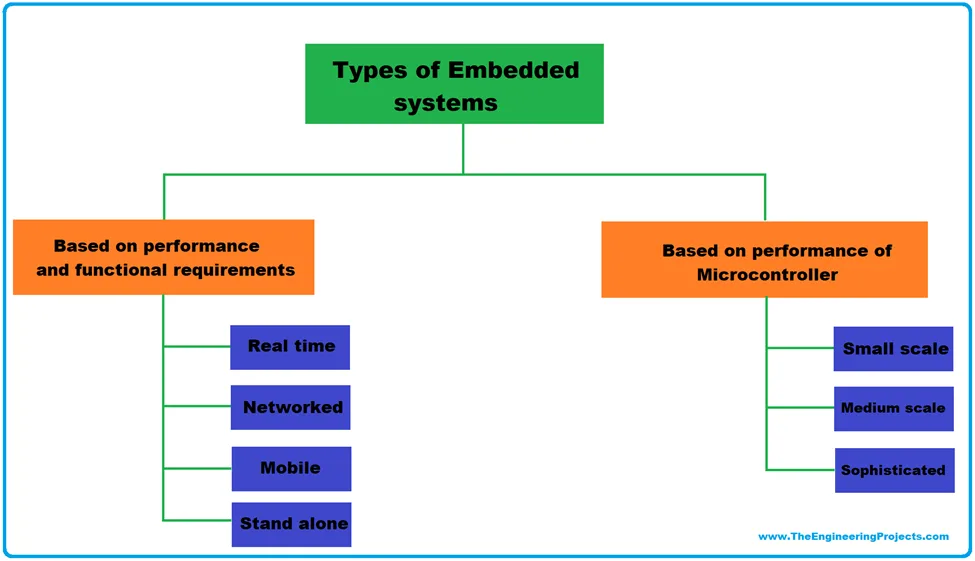
- Based on Performance and Functional Requirements
This classification focuses on how the embedded system performs its assigned task and how it interacts with users or other systems.
- Real-Time Embedded Systems
A real-time embedded system performs tasks within a specified time limit. The correctness of its operation depends not only on producing the correct output but also on producing it at the right time.
Characteristics
- Immediate response to events
- High reliability
- Deterministic operation
- Time-critical applications
Examples
- Video conferencing
- Online gaming
- Multimedia streaming
- Networked Embedded Systems
Networked embedded systems communicate with other devices through wired or wireless networks. They exchange data and can often be monitored or controlled remotely.
Characteristics
- Internet connectivity
- Remote monitoring
- Data sharing
- Device-to-device communication
Examples
- Smart home automation
- Smart electricity meters
- Network printers
- Industrial monitoring systems
- IoT devices
- Mobile Embedded Systems
Mobile embedded systems are portable devices powered by rechargeable batteries. They are designed for mobility, compactness, and energy efficiency.
Characteristics
- Portable
- Battery operated
- Wireless communication
- Lightweight
Examples
- Smartphones
- Tablets
- Smartwatches
- GPS navigation devices
- Fitness trackers
- Standalone Embedded Systems
Standalone embedded systems operate independently without requiring connection to another computer or network.
Characteristics
- Performs dedicated tasks
- Self-contained
- User-friendly
- Independent operation
Examples
- Microwave ovens
- Digital cameras
- Washing machines
- Electronic calculators
- Air conditioners
- Based on the Performance of the Microcontroller
This classification depends on the processing power, memory capacity, and complexity of the embedded system.
- Small-Scale Embedded Systems
Small-scale embedded systems use simple microcontrollers with limited memory and processing capability.
Features
- 8-bit or 16-bit microcontrollers
- Small memory
- Low cost
- Low power consumption
Examples
- TV remote controls
- Digital clocks
- Toys
- LED displays
- Temperature controllers
- Medium-Scale Embedded Systems
Medium-scale embedded systems use more powerful processors and larger memory than small-scale systems. They support more complex applications.
Features
- 16-bit or 32-bit microcontrollers
- Moderate processing speed
- Larger memory
- Supports multitasking
Examples
- Smart washing machines
- Medical monitoring devices
- Industrial controllers
- Security systems
- Point-of-sale (POS) terminals
- Sophisticated Embedded Systems
Sophisticated embedded systems are highly advanced systems designed for complex applications requiring powerful processors, large memory, and often real-time operating systems (RTOS).
Features
- High-performance processors
- Large memory capacity
- Advanced communication interfaces
- Real-Time Operating System (RTOS)
- Artificial Intelligence (AI) capability
- Multi-core processors
Examples
- Autonomous vehicles
- Modern aircraft control systems
- Industrial robots
- Medical imaging equipment
- Smart manufacturing systems
- Advanced defense systems
- Advantages, Disadvantages and applications of Embedded System
5.1. Advantages of Embedded System
- Easy to produce higher production
- Fewer prices for per piece of resultant
- It has very few interconnections.
- Better stable
- Higher reliable
- To use for one task
- Portable due to small in size
- Low power consumption
- Better accuracy in result
- Higher speed
5.2. Disadvantages of Embedded System
- Difficult to maintain
- Difficult to take a back-up of embedded files
- You have to reset all setting, due to happen any problem in the system.
- Troubleshooting is Harder
- Harder to move data from one system to other system
- Limitations for hardware, due to make it for specific task
- Less power supply durability
- Limited resources for memory
- To need higher development efforts for designing an embedded system
- Require to long time to market
- Application areas of Embedded System:
Mostly Embedded systems are present everywhere. We use it in our everyday life unknowingly as in most cases it is integrated into the larger systems.
Embedded systems’ mostly area of application
- Home appliances
- Transportation
- Health care
- Business sector & offices
- Defense sector
- Aerospace
- Agricultural Sector
- Roles of Microcontrollers in Modern Embedded Systems
- Processing Data
The microcontroller acts as the brain of an embedded system. It receives data from sensors or user inputs, processes the information according to the programmed instructions, and makes decisions.
Example: In a digital thermometer, the microcontroller reads the temperature sensor, calculates the temperature value, and displays the result on an LCD screen.
- Controlling Input and Output Devices
Microcontrollers manage communication between input devices (such as sensors and switches) and output devices (such as LEDs, displays, motors, and buzzers).
Example: In an automatic irrigation system, the microcontroller receives soil moisture data from a sensor and turns a water pump on or off depending on the moisture level.
- Real-Time Processing
Many embedded systems require immediate responses to external events. Microcontrollers perform real-time processing, ensuring that tasks are completed within strict timing requirements.
Example: In a vehicle airbag system, the microcontroller detects a collision and deploys the airbag within milliseconds to protect passengers.
- Sensor Data Acquisition
Microcontrollers collect information from various sensors, including:
- Temperature sensors
- Humidity sensors
- Motion sensors
- Pressure sensors
- Light sensors
- Gas sensors
The collected data is processed and used to make intelligent decisions.
Example: A smart greenhouse uses sensors to monitor temperature and humidity, allowing the microcontroller to control fans and irrigation systems automatically.
- Communication Between Devices
Modern microcontrollers support communication protocols that enable embedded systems to exchange data with other devices.
Example: A smart electricity meter transmits electricity consumption data to a utility company using wireless communication.
- Power Management
Microcontrollers are designed to consume very little power, making them ideal for battery-powered devices. Many include low-power or sleep modes to extend battery life.
Applications:
- Smartwatches
- Fitness trackers
- Wireless sensors
- Remote controls
- Supporting Internet of Things (IoT)
Microcontrollers play a key role in IoT systems by connecting devices to the internet. They collect sensor data, communicate with cloud platforms, and receive commands from users.
Example: A smart home system allows users to control lights, fans, and security cameras remotely using a smartphone application.

You may also like

Nyereka Tech and Tumba College Explore Opportunities for Collaboration

The Launch of our IoT Innovation Hub