


1.3 Microcontroller vs Microprocessor
1.3.1 Introduction
Microcontrollers are small programmable devices that are widely used to control and manage electronic systems. They combine important components such as a processor, memory, input/output ports, timers, and communication interfaces into a single chip. Because of their small size, low cost, low power consumption, and flexibility, microcontrollers are commonly used in embedded systems.
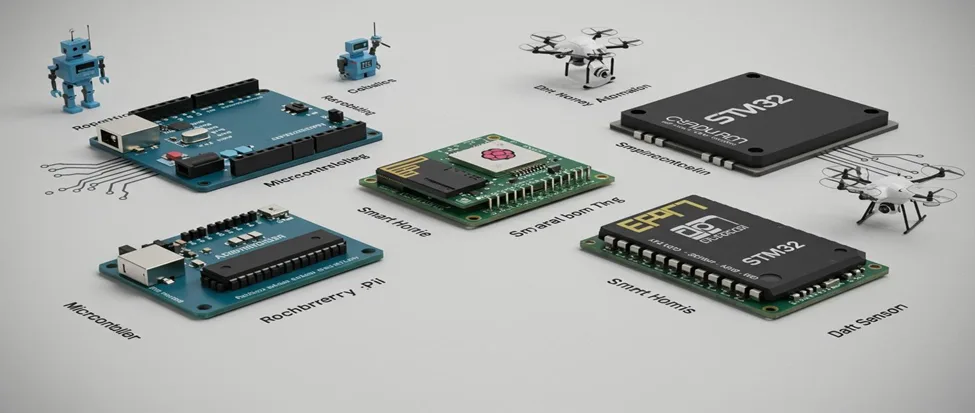
Microcontrollers are found in many applications, including household appliances, automobiles, medical equipment, industrial machines, robotics, security systems, and Internet of Things (IoT) devices. Different types of microcontrollers are available, with different processing capabilities and features to meet the requirements of various applications.
In this section, learners will explore the fundamentals of microcontrollers, the difference between microcontrollers and microprocessors, the major types of microcontrollers, and their common applications. This knowledge provides a foundation for understanding how microcontrollers are selected, programmed, and used to develop modern electronic and embedded systems.
1.3.2. Fundamentals of Microcontrollers
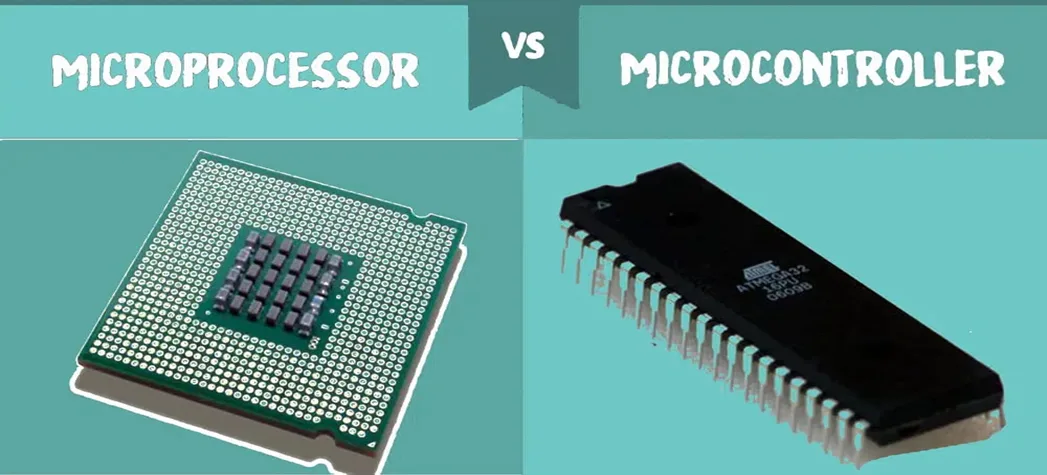
A microcontroller is a small programmable integrated circuit (IC) that contains a processor, memory, and input/output peripherals on a single chip.
A microcontroller is a tiny, self-contained computer on a single integrated circuit.
A microprocessor is a programmable electronic component that contains only the Central Processing Unit (CPU) on a single chip.
A microprocessor is a small integrated circuit (IC) that acts as the brain of a computer or electronic device.
1.3.3 Basic Structure of a Microcontroller

A microcontroller consists of several important components that work together to perform control and processing tasks.
The major components of a microcontroller include the
- Central Processing Unit (CPU),
- Memory
- Input/output (I/O) Ports.
These three components form the core of a microcontroller system. However, other components such as timers, communication interfaces, and converters also play important supporting roles in improving the functionality and performance of the microcontroller.
The following sections explain the main components of a microcontroller and their functions.
- Central Processing Unit (CPU)
The Central Processing Unit (CPU) is the main processing unit and is often considered the brain of the microcontroller. It controls all operations by reading, interpreting, and executing instructions stored in the memory.
The CPU consists of two main parts:
- Arithmetic Logic Unit (ALU): Performs arithmetic operations such as addition and subtraction, as well as logical operations such as comparisons and decision-making.
- Control Unit (CU): Controls the execution sequence of instructions and manages communication between different components of the microcontroller.
The CPU performs three main operations:
- Fetching instructions from memory.
- Decoding the instructions to understand the required operation.
- Executing the instructions to perform calculations, logical operations, or data transfers.
- Memory
Memory is an essential component of a microcontroller because it stores programs, instructions, and data required during operation. Microcontrollers usually contain two main types of memory:
- a) Program Memory
Program memory stores the instructions or program code that the CPU executes. It is usually non-volatile memory, meaning that the stored information remains even when power is removed.
Examples include:
- ROM (Read Only Memory)
- Flash Memory
- b) Data Memory
Data memory stores temporary information generated while the program is running. It allows the CPU to read and write data during operation.
The main type of data memory is:
- RAM (Random Access Memory)
RAM is also known as Read/Write Memory because data can be stored, modified, and removed during program execution.
- Input/Output (I/O) Ports
Input/Output (I/O) ports provide communication between the microcontroller and external devices. They allow the microcontroller to receive information from input devices and send signals to output devices.
Input Devices
Input devices provide data to the microcontroller. Examples include:
- Sensors
- Switches
- Keypads
- Push buttons
The CPU processes the received information according to the programmed instructions.
Output Devices
Output devices receive signals from the microcontroller to perform specific actions. Examples include:
- LEDs
- Displays
- Motors
- Relays
- Printers
For example, a temperature sensor can provide input data to the microcontroller, which then controls a fan or displays the temperature value.
- System Bus
The System Bus is a group of electrical connections that allows communication between the CPU, memory, I/O ports, and other internal components of the microcontroller.
The system bus transfers three main types of information:
- Data: Transfers actual information between components.
- Address: Identifies the location where data is stored or retrieved.
- Control signals: Manage communication and synchronization between components.
The system bus ensures that all parts of the microcontroller work together efficiently.
- Timers and Counters
Timers and counters are important components used for measuring time intervals and counting events.
Timers
Timers are used to generate accurate time delays and control time-based operations.
Applications include:
- Creating delays
- Generating clock signals
- Controlling communication timing
Counters
Counters are used to count external events, such as the number of objects detected by a sensor.
Other functions of timers and counters include:
- Pulse Width Modulation (PWM)
- Frequency measurement
- Motor speed control
- Serial Communication Ports
Microcontrollers often need to communicate with external devices or other microcontrollers. Serial communication ports provide this connection by transmitting data one bit at a time.
Common serial communication methods include:
- UART (Universal Asynchronous Receiver/Transmitter)
- SPI (Serial Peripheral Interface)
- I²C (Inter-Integrated Circuit)
- CAN (Controller Area Network)
Serial communication is commonly used to connect sensors, displays, wireless modules, and other electronic devices.
- Interrupt System
An interrupt is a mechanism that allows the microcontroller to temporarily stop its current operation and respond immediately to an important event.
Interrupts can be generated by:
- External devices (such as sensors or switches)
- Internal hardware components
- Software instructions
For example, when a sensor detects an emergency condition, an interrupt can immediately notify the CPU to process the event.
Interrupts improve the speed and efficiency of microcontroller-based systems.
- Analog-to-Digital Converter (ADC)
An Analog-to-Digital Converter (ADC) is a component that converts analog signals into digital values that can be processed by the CPU.
Many real-world signals are analog, such as:
- Temperature
- Light intensity
- Pressure
- Sound
Since microcontrollers process digital information, ADCs are required to convert analog sensor signals into digital data.
Example:
A temperature sensor produces an analog voltage signal. The ADC converts this voltage into a digital value that the microcontroller can understand and process.
- Digital-to-Analog Converter (DAC)
A Digital-to-Analog Converter (DAC) performs the opposite function of an ADC. It converts digital signals from the microcontroller into analog signals.
DACs are used when a microcontroller needs to control analog devices.
Applications include:
- Audio signal generation
- Motor control
- Signal processing
- Industrial control systems
The DAC provides communication between the digital processing system of the microcontroller and external analog devices.
1.3.4 How a Microcontroller Works
A microcontroller works as a small programmable computer that receives input information, processes the data according to a stored program, and produces the required output. It operates by executing a sequence of instructions stored in its memory to control electronic devices and systems.
The working principle of a microcontroller can be explained through the basic process of Input → Processing → Output.

The microcontroller continuously reads data from input devices, processes the information using its CPU, and sends commands to output devices to perform specific actions.
For example, in a smart lighting system:
- A light sensor detects the surrounding brightness.
- The microcontroller processes the sensor data.
- It decides whether the environment is dark or bright.
- It turns the light ON or OFF.
- The process repeats continuously.

You may also like

Nyereka Tech and Tumba College Explore Opportunities for Collaboration

The Launch of our IoT Innovation Hub