


2.7. Fixation of electronic components on PCB
2.7.1. Introduction on fixation of electronic components on PCB
Fixation of electronic components on a PCB means physically attaching electronic components to the printed circuit board so that they remain firmly in place and have reliable electrical connections.
There are two main methods:
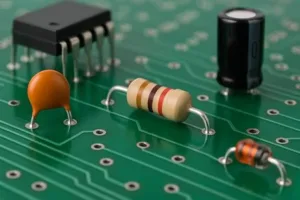
1. Through-Hole Technology (THT)
In THT, component leads are inserted through holes in the PCB and soldered on the opposite side.
In THT, component leads are inserted through holes in the PCB and soldered on the opposite side.
process:
Component lead → PCB hole → Solder → Mechanical + electrical connection
THT components are generally mechanically strong and are commonly used for connectors and components that experience physical stress.
2. Surface-Mount Technology (SMT)
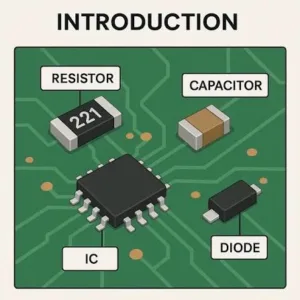
In SMT, components are placed directly onto copper pads on the surface of the PCB.
The component is held in position using solder paste, and then the board is heated in a reflow soldering process.
process:
Copper pad → Solder paste → Component → Reflow soldering → Permanent connection
Soldering
Soldering is the main method used to permanently fix electronic components to the PCB.
The solder provides both:
- Mechanical fixation — holds the component in place.
- Electrical connection — allows current and signals to flow between the component and PCB.
Soldering methods
1. Hand Soldering Using a Soldering Iron
Hand soldering is a method of joining electronic components to a PCB manually using a soldering iron and solder wire.
The soldering iron heats the component lead and PCB pad, then solder is melted to form an electrical and mechanical connection
Commonly used for:
- Repairing PCBs
- Prototyping
- Small production quantities
- Replacing individual components
SOLDELING VIDEO USING SOLDERING IRON
2. Wave Soldering
Wave soldering is an automated soldering process mainly used for through-hole components (THT).
The PCB passes over a wave of molten solder. The exposed component leads come into contact with the molten solder, which forms solder joints.
Basic process:
PCB → Flux application → Preheating → Molten solder wave → Cooling
Commonly used for:
- Mass production
- Through-hole components
- Large numbers of components
SOLDELING VIDEO USING WAVE SOLDERING
3. Reflow Soldering
Reflow soldering is an automated process mainly used for surface-mount components (SMT).
First, solder paste is applied to the PCB pads. Components are placed on the solder paste, and the PCB is heated in a reflow oven. The solder paste melts and then cools, permanently attaching the components.
Basic process:
Solder paste → Component placement → Heating → Solder melts → Cooling → Solder joint
Commonly used for:
- SMD resistors and capacitors
- ICs
- Microcontrollers
- Mass PCB production
SOLDELING VIDEO USING REFLOW SOLDERING
4. Mechanical fixation
Some components may require additional physical support, especially large or heavy components.
Examples include:
- Screws and nuts
- Clips
- Brackets
- Adhesive
- PCB mounting spacers
For example, a large transformer may be mechanically secured with screws while its electrical terminals are soldered to the PCB.

You may also like

Nyereka Tech and Tumba College Explore Opportunities for Collaboration
The Launch of our IoT Innovation Hub