


Identify and describe the main components
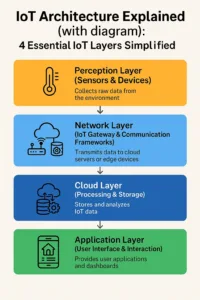
An IoT system is made up of multiple layers that work together seamlessly. Understanding each layer helps you design, build, and troubleshoot IoT solutions. The four main layers are: Perception, Network, Processing, and Application.
The Four-Layer IoT Architecture
Layer 1: Perception Layer (Things Layer)
This is the physical layer ; the “eyes and hands” of the IoT system. It includes all the hardware that interacts with the real world.
- Sensors: Devices that collect data. Examples: temperature sensors (DHT11/DHT22), motion sensors (PIR), light sensors (LDR), humidity sensors, GPS modules, accelerometers.
- Actuators: Devices that perform actions. Examples: motors, relays, LEDs, buzzers, solenoid valves, servo motors.
- Microcontrollers/Processors: The “brain” of the device that controls sensors and actuators. Examples: Arduino Uno, ESP32, Raspberry Pi.
- Power Supply: Batteries, solar panels, or mains power that keep devices running.
Layer 2: Network Layer (Connectivity Layer)
Once data is collected, it must be transmitted. The network layer handles communication between devices and between devices and the cloud.
| Technology | Characteristics | Common Use |
| Wi-Fi | High bandwidth, short range | Smart home devices, IP cameras |
| Bluetooth / BLE | Low power, very short range | Wearables, health monitors |
| Zigbee / Z-Wave | Low power, mesh network | Smart lighting, building automation |
| LoRa / LoRaWAN | Very long range, low power | Agriculture, smart cities |
| NB-IoT / LTE-M | Cellular, wide area coverage | Asset tracking, meters |
| Ethernet | Wired, high reliability | Industrial IoT, fixed installations |
Layer 3: Processing Layer (Middleware / Fog / Edge Layer)
Raw data from sensors is processed at this layer. Processing can happen at three levels:
- On-device (Edge): The microcontroller processes data locally for fast responses. Ideal when low latency is critical (e.g., an alarm that triggers immediately).
- Fog Computing: Processing happens on a local gateway or edge server before sending to the cloud. Reduces bandwidth and latency.
- Cloud Computing: Data is sent to remote servers for heavy processing, storage, analytics, and machine learning. Examples: AWS IoT Core, Google Cloud IoT, Microsoft Azure IoT Hub.
Layer 4: Application Layer
This is where end users interact with the IoT system. The application layer presents processed data in a useful format and allows control of devices.
- Dashboards: Visual interfaces showing real-time sensor data, charts, and alerts (e.g., Grafana, ThingsBoard).
- Mobile Apps: Smartphone applications for monitoring and control.
- APIs: Interfaces that allow third-party software to access IoT data.
- Automation Rules: Logic that triggers actions based on conditions (e.g., “if temperature > 30°C, turn on fan”).
| NOTE | In simple IoT projects, these four layers might run on just two devices: a microcontroller and a smartphone app. In industrial systems, each layer can involve hundreds of components. |
Hardware Components in Detail
Microcontrollers vs Microprocessors
| Primary role | Control sensors and actuators |
| Operating system | Usually none (bare-metal) |
| Power consumption | Very low (milliwatts) |
| Examples | Arduino Uno, ESP8266, ATmega328 |
| Best for | Simple, dedicated IoT tasks |
Common Sensors You Will Use in This Course
| Sensor | Function | Application |
| DHT11 / DHT22 | Temperature and humidity sensing | Weather stations, HVAC control |
| PIR Sensor | Detecting motion via infrared | Security systems, automatic lights |
| Ultrasonic (HC-SR04) | Measuring distance using sound | Obstacle avoidance, water level |
| LDR (Light Dependent Resistor) | Measuring light intensity | Automatic street lights |
| MQ-2 / MQ-135 | Detecting gas concentrations | Air quality, smoke detectors |
| GPS Module (NEO-6M) | Determining geographic location | Vehicle tracking, mapping |
Software Components
IoT systems require software at every layer:
- Firmware: Low-level code running on microcontrollers, written in C/C++ or MicroPython.
- Device drivers: Software that allows the processor to communicate with specific hardware.
- Communication middleware: Libraries and protocols that handle data transmission (e.g., MQTT client libraries).
- Cloud platforms: Software services for ingesting, storing, and visualizing IoT data.
- Analytics engines: Tools for processing large volumes of sensor data and identifying patterns.
Check Your Understanding — Lesson 0.2
- Draw and label the four layers of the IoT architecture with one example component at each layer.
- A farmer wants to monitor soil moisture remotely and automatically water crops. Name two sensors, one communication technology, and one type of actuator they would need.
- What is the difference between edge computing and cloud computing? When would you choose one over the other?
Watch this Video

You may also like

Nyereka Tech and Tumba College Explore Opportunities for Collaboration
The Launch of our IoT Innovation Hub