

IoT Workshop 1: From Zero to Your First Connected Device
Prerequisites
- Enrolled in the course on nedu.rw
- Laptop running Windows, macOS, or Linux (Chromebooks not supported)
- Aged 18 or over
What to bring
- Laptop with Arduino IDE 2.x installed (free at arduino.cc)
- A data-transfer USB cable (not charge-only)
- Laptop charger
All hardware (ESP32 board, sensors, wires) is provided free on the day.
By registering you confirm you meet the above and will attend the full day: 08:30 – 17:00.
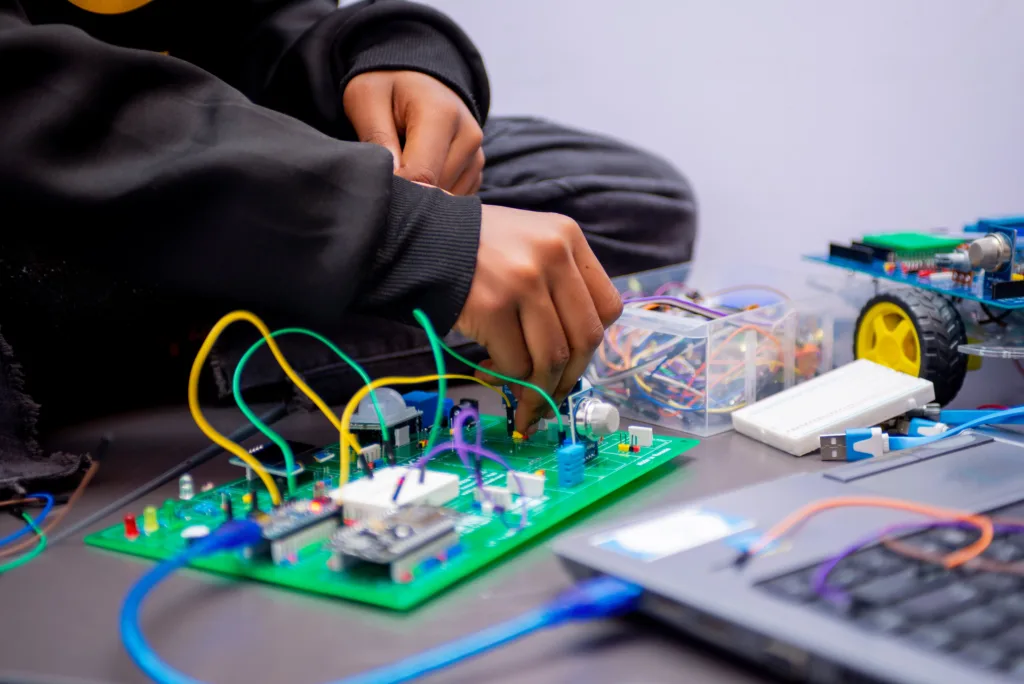
This workshop is open to anyone enrolled in Build Smart: IoT Engineering from Zero to Deployment on nedu.rw. You do not need any background in electronics, programming, or networking; the day starts from zero. Nyereka Tech will provide: ESP32 development boards, DHT22 temperature and humidity sensors, breadboards, jumper wires, LEDs, resistors, and USB power adapters. You do not need to buy any hardware in advance.
| Time | Session | What You’ll Do |
|---|---|---|
| 08:30 | Registration & Setup | Laptops out, Arduino IDE checked, boards distributed |
| 09:00 | Welcome & Course Map | What the 10-unit course covers; what today achieves; safety rules for working with electronics |
| 09:20 | Unit 1 — Electricity Basics | Voltage, current, resistance, and Ohm’s Law explained with live demonstrations; reading resistor colour codes; building a simple LED circuit on a breadboard |
| 10:30 | Break | — |
| 10:50 | Unit 2 — Meet the ESP32 | Board overview; GPIO pins; connecting the ESP32 to your laptop; first sketch upload — blink an LED from firmware |
| 12:00 | Lunch Break | — |
| 13:00 | Unit 3 — First Firmware | Variables, loops, and functions in C/C++; reading Serial Monitor output; non-blocking timing with millis() |
| 14:00 | Unit 4 — First Sensor | Wiring a DHT22 temperature and humidity sensor to the ESP32; installing the DHT library; reading and printing sensor values to Serial Monitor |
| 15:00 | Break | — |
| 15:15 | Cloud Connection | Connecting the ESP32 to Wi-Fi; creating a free ThingsBoard account; publishing live sensor data to a dashboard; viewing data on your phone |
| 16:15 | Show & Share | Each student shows their running dashboard; group troubleshooting of any remaining issues |
| 16:45 | Wrap-Up & Next Steps | What Units 5–10 will build on today’s foundation; online course access; community group link |
| 17:00 | End | Workshop concludes |
What you will build and take away
By 17:00 every participant will have:
-
A working breadboard circuit: ESP32 + DHT22 sensor + LED, fully wired and tested
-
Firmware they wrote themselves, running on the board
-
A free ThingsBoard cloud account with a live dashboard showing real temperature and humidity readings from their own sensor
-
Access to the full online course (Units 1–10) to continue at their own pace after the workshop
-
An invite to the NEDU IoT community group for peer support and updates on Workshop 2
Hardware & What You Keep
The circuit stays with NEDU Rwanda (hardware is reused across workshops), but the firmware code and the dashboard are yours to keep and build on throughout the online course.
Logistics
| Information | Details |
|---|---|
|
Date |
30, October 2024 |
| Time | 08:30 – 17:00 |
| Venue | Kigali, Rwanda — venue address sent to registered participants one week before the event |
| Cost | Free — open to all enrolled students |
| Capacity | Limited places; first-come, first-served |
| Language | English (Kinyarwanda support available on the day) |
| Enrollment | nedu.rw/learn/internet-of-things-and-smart-systems |
| Questions | Reply to your enrolment confirmation email or contact the NEDU team at nedu.rw |
Enroll in the course first
Workshop invitations are sent only to enrolled students.