


3.4 SURFACE-MOUNT (SMD) SOLDERING TECHNIQUES
Overview
Surface-mount devices (SMDs) are widely used in modern electronics because they allow manufacturers to produce smaller and more compact circuits. SMD soldering stands for Surface-Mount Device soldering. It is the process of attaching electronic components directly onto the surface of a printed circuit board (PCB) by soldering their terminals to conductive pads on the board.
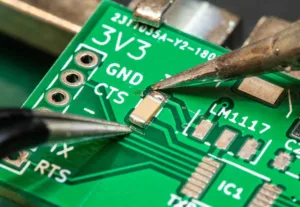
Unlike through-hole soldering, SMD components generally do not have long leads that pass-through holes in the PCB. This lesson introduces basic techniques for soldering common SMD components.
Preparing for SMD soldering
Before soldering SMD (Surface-Mount Device) components, the technician should carry out the following preparation:
- Clean the work area – Remove dust, dirt, and unnecessary materials from the workbench.
- Prepare the PCB – Clean the soldering pads using isopropyl alcohol and ensure they are free from oxidation or old solder.
- Identify the component – Check the component type, value, orientation, and correct position on the PCB.
- Prepare the soldering tools – Ensure the soldering iron, fine tip, solder, flux, tweezers, and other tools are clean and ready.
- Use ESD protection – Wear an ESD wrist strap and use an ESD-safe work surface when handling sensitive SMD components.
- Apply flux if necessary – Apply a small amount of suitable flux to the pads to improve solder flow.
- Check the component and PCB – Make sure the component and soldering pads are not damaged before starting.
Soldering small SMD components
For simple SMD components such as resistors and capacitors:
- Apply a small amount of solder to one PCB pad.
- Position the component using tweezers.
- Heat the soldered pad and secure one side of the component.
- Solder the other side.
- Inspect both connections.
Only a small amount of solder is normally required because SMD pads and components are small.
Soldering SMD integrated circuits
SMD ICs have multiple closely spaced pins. Careful positioning and controlled solder application are important.

A technique called drag soldering can be used on suitable components. The soldering iron is moved along a row of pins while a controlled amount of solder forms connections.
Safety reminder: SMD soldering often requires magnification and fine tools. Avoid excessive heat, which can damage small components and PCB pads.
Professional tip: Work slowly when positioning SMD components. Correct alignment before soldering can prevent many problems later.
Common mistake: Using too much solder on small SMD components can create solder bridges between adjacent pads.
Summary
In this lesson, you learned the basic principles of SMD soldering, including component preparation, positioning, soldering small components, and basic drag soldering. Accuracy, controlled heat, and careful solder application are essential when working with SMD components.

You may also like

Nyereka Tech and Tumba College Explore Opportunities for Collaboration

The Launch of our IoT Innovation Hub