


2.3 ELECTRONIC COMPONENTS AND PRINTED CIRCUIT BOARDS (PCBs)
Overview
Before soldering electronic components, it is important to understand the parts you will be working with. This lesson introduces common electronic components, printed circuit boards (PCBs), and how they should be prepared before soldering.
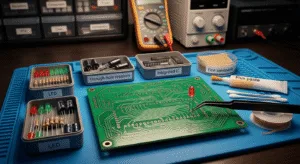
Electronic components
Electronic components are the building blocks of electronic circuits. Each component performs a specific function, such as controlling current, storing energy, or processing signals.
Examples include:
- Resistors
- Capacitors
- Diodes
- Transistors
- Integrated Circuits (ICs)
- Connectors
Each component must be installed correctly to ensure the circuit functions as intended.
Printed circuit boards (PCBs)
A Printed Circuit Board (PCB) is a board that mechanically supports and electrically connects electronic components using copper tracks. PCBs make electronic circuits compact, organized, and reliable.
Types of electronic components
Through-hole components
These components have leads that pass through holes in the PCB and are soldered on the opposite side. They provide strong mechanical support and are commonly used in prototypes and educational projects.
Surface-mount components (SMD)
These components are soldered directly onto the surface of the PCB. They are much smaller than through-hole components and are widely used in modern electronic devices.

Preparing components and PCBs
Good preparation reduces soldering errors and improves the quality of the finished circuit.
Before soldering:
- Inspect the PCB for damage.
- Ensure component leads and PCB pads are clean.
- Place each component in the correct position.
- Verify the orientation of polarized components, such as diodes and electrolytic capacitors.
Professional tip: Take time to identify each component before soldering. Correct component placement is just as important as making a good solder joint.
Safety reminder: Handle electronic components carefully to avoid damaging them. Some components are sensitive to electrostatic discharge (ESD).
Common mistake: Many beginners solder components without checking their orientation. Always verify the correct position before heating the joint.
Key takeaways
- Electronic components perform different functions in a circuit.
- A PCB supports and connects electronic components.
- Components can be through-hole or surface-mount.
- Proper preparation helps prevent soldering mistakes.
Summary
In this lesson, you learned about common electronic components, the purpose of a PCB, the difference between through-hole and surface-mount components, and the importance of preparing components and PCBs before soldering.

You may also like

Nyereka Tech and Tumba College Explore Opportunities for Collaboration

The Launch of our IoT Innovation Hub