

Introduction to Embedded system
Introduction to embedded system
I. What is an Embedded System?
An embedded system is a combination of computer software and hardware which is either fixed in capability or programmable.
An embedded system can be either an independent system, or it can be a part of a large system. It is mostly designed for a specific function.
For example, a fire alarm is a common example of an embedded system which can sense only smoke.
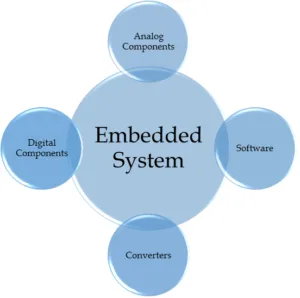
II. Components of Embedded system
Analog Components
Analog Components are very necessary components of such a system. They are important because they help in interacting with real world. Examples of analog components are:
- Sensors
- Actuators
- Controllers
Digital Components
Digital components mostly reside on the chip and do the processing operations. Examples are:
- Processors
- Co-processors
- Memory
- Controllers
- Buses
- Application Specific Integrated Circuits (ASIC)
Converters
Converters are very important building blocks. They are useful so that digital and analog components can work together. For example:
- Analog to Digital Converter (A2D)
- Digital to Analog Converter (D2A)
Software
Without software an embedded system cannot work. The software is written in high level language. This software is burnt to some non-volatile memory. Examples are:
- Application Programs
- Exception Handlers
III. Understanding Embedded System
Following are important characteristics of an embedded system:
- Requires real time performance
- It should have high availability and reliability
- Developed around a real-time operating system
- Usually, have easy and a diskless operation, ROM boot
- Designed for one specific task
- It must be connected with peripherals to connect input and output devices
- Offers high reliability and stability
- Needed minimal user interface
- Limited memory, low cost, fewer power consumptions
- It does not need any secondary memory in computer
Important terminologies used in embedded system
Here, are important terms used in embedded system.
Reliability: This measure of the survival probability of the system when the function is critical during the run time.
Fault-Tolerance: Fault-Tolerance is the capability of a computer system to survive in the presence of faults.
Real-Time: Embedded system must meet various timing and other constraints. They are imposed on it by the real-time natural behavior of the external world.
For example, an air force department which keeps track of incoming missile attacks must precisely calculate and plan their counter-attack due to hard real-time deadline. Otherwise, it’ll get destroyed.
Flexibility: It’s building systems with built-in debugging opportunities which allows remote maintenance.
For example, you are building a spacecraft which will land on another planter to collect various types of data and send collected detail back to us. If this spacecraft went insane and lost the control, we should be able to make some important diagnostic. So, flexibility is vital while designing an embedded system.
Portability: Portability is a measure of the ease of using the same embedded software in various environments. It requires generalized abstractions between the application program logic itself and the low-level system interfaces.
Types of Embedded System
Three types of Embedded Systems are:
Small Scale Embedded Systems:
- If the microcontroller used in embedded system is 8 bit or 16 bit then it is classified into small scale embedded system.
- Such systems have less complex hardware and software parts and can also be operated on batteries.
- Normally such embedded system uses Arduino boards or PIC Microcontrollers or 8051 Microcontrollers etc.
Medium Scale Embedded Systems:
- The second class is medium scale embedded system
- It uses one or more than one 16 bit or 32 bit microcontrollers
- It may use DSP (digital signal processor) or may use RISC (reduced instruction set computer)
- Hardware and software of these systems are complex
Sophisticated Embedded Systems
- The third class of embedded systems is sophisticated
- Such systems have huge hardware and software complexity
- So they need PLA (programmable logic array), scalable or configurable processors
- These systems have speed constraints.
Advantages of Embedded System
- It is able to cover a wide variety of environments
- Less likely to encore errors
- Embedded System simplified hardware which, which reduces costs overall
- Offers an enhanced performance
- The embedded system is useful for mass production
- The embedded system is highly reliable
- It has very few interconnections
- The embedded system is small in size
- It has a fast operation
- Offers improved product quality
- It optimizes the use of system resources
- It has a low power operation
Disadvantages of Embedded System
Here, are important cons/ drawbacks of using Embedded system.
- To develop an embedded system needs high development effort
- It needs a long time to market
- Embedded systems do a very specific task, so it can’t be programmed to do different things
- Embedded systems offer very limited resources for memory
- It doesn’t offer any technological improvement
- It is difficult to backup of embedded files
IV. Microprocessor vs Microcontroller
| Microprocessor | Microcontroller |
|---|---|
| It uses functional blocks like register, ALU, timing, and control units. | It uses functional blocks of microprocessors like RAM, timer, parallels I/O, ADC, and DAC. |
| In Microprocessor, bit handling instruction is less, One or two types only. | Microcontroller offers many kinds of bit handling instruction. |
| Offers rapid movements of code and data between external memory and microprocessor. | Offers rapid movements of code and data in the microcontroller. |
| Helps you to design general purpose digital computers system. | Helps you to design application-specific dedicated systems. |
| It allows you to do multitasking at a time. | It is a single task oriented system. |
| In Microprocessor system, you can decide the number of memory or I/O ports needed. | In Microcontroller system, the fixed number for memory or I/O makes a microcontroller ideal to complete the specific task. |
| Offers support for external memory and I/O ports, which makes it heavier and costlier system. | This type of system is lightweight and cheaper compares to the microprocessor. |
| External devices need more space, and their power consumption is quite higher. | This type of system consumes less amount of space, and power consumption is also very low. |
V. Common features of Micro-controller
- CPU – Microcontrollers brain is named as CPU. CPU is the device that is employed to fetch data, decode it, and at the end complete the assigned task successfully. With the help of the CPU, all the components of the microcontroller are connected to a single system.
- Memory – In a microcontroller memory chip works the same as the microprocessor. Memory chip stores all programs & data.
- Input/output ports – I/O ports are basically employed to interface or drive different appliances such as as- printers, LCDs, LEDs, etc.
- Serial Ports – These ports give serial interfaces and microcontroller & various other peripherals such as parallel port.
- Timers – A microcontroller may be in-built with one or more timers or counters. The timers & counters control all counting & timing operations within a microcontroller. Timers are employed to count external pulses. The main operations performed by timers are- pulse generations, clock functions, frequency measuring, modulations, making oscillations, etc.
- ADC (Analog to digital converter) – ADC is employed to convert analog signals to digital ones. The input signals need to be analog for ADC. Digital signal production can be employed for different digital applications (such as as- measurement gadgets).
- DAC (digital to analog converter) – this converter executes opposite functions that ADC performs. This device is generally employed to supervise analog appliances like- DC motors, etc.
- Interpret Control- This controller is employed for giving delayed control for a working program. Interpreting can be internal or external.
- Special Functioning Block – Some special microcontrollers manufactured for special appliances like- space systems, robots, etc, comprise this special function block. This special block has additional ports so as to carry out some special operations.
VI. Different types of micro-controllers
Types of Microcontroller:
Microcontrollers are divided into categories according to their memory, architecture, bits, and instruction sets. So let’s discuss types of microcontrollers:
- 8-bits microcontroller executes logic & arithmetic operations. An example of 8 bits microcontroller is Intel 8031/8051.
- 16-bits microcontroller executes with greater accuracy and performance in contrast to 8-bit. An example of a 16-bit microcontroller is Intel 8096.
- 32 bits microcontroller is employed mainly in automatically controlled appliances such as office machines, implantable medical appliances, etc. It requires 32-bit instructions to carry out any logical or arithmetic function.
Memory:
- External Memory Microcontroller – When an embedded structure is built with a microcontroller that does not comprise of all the functioning blocks existing on a chip it is named as external memory microcontroller. For illustration- the 8031 microcontroller does not have program memory on the chip.
- Embedded Memory Microcontroller – When an embedded structure is built with a microcontroller that comprises all the functioning blocks existing on a chip it is named an embedded memory microcontroller. For illustration- 8051 microcontroller has all program & data memory, counters & timers, interrupts, I/O ports, and therefore its embedded memory microcontroller.
Instruction Set:
- CISC- CISC means complex instruction set computer, it allows the user to apply 1 instruction as an alternative to many simple instructions.
- RISC- RISC means Reduced Instruction Set Computers. RISC reduces the operation time by shortening the clock cycle per instruction.
Memory Architecture:
- Harvard Memory Architecture Microcontroller
- Princeton Memory Architecture Microcontroller
Thanks for reading this chipter 1

You may also like

Nyereka Tech and Tumba College Explore Opportunities for Collaboration

The Launch of our IoT Innovation Hub